London-Derry Connections, 1613-1640

Posted on

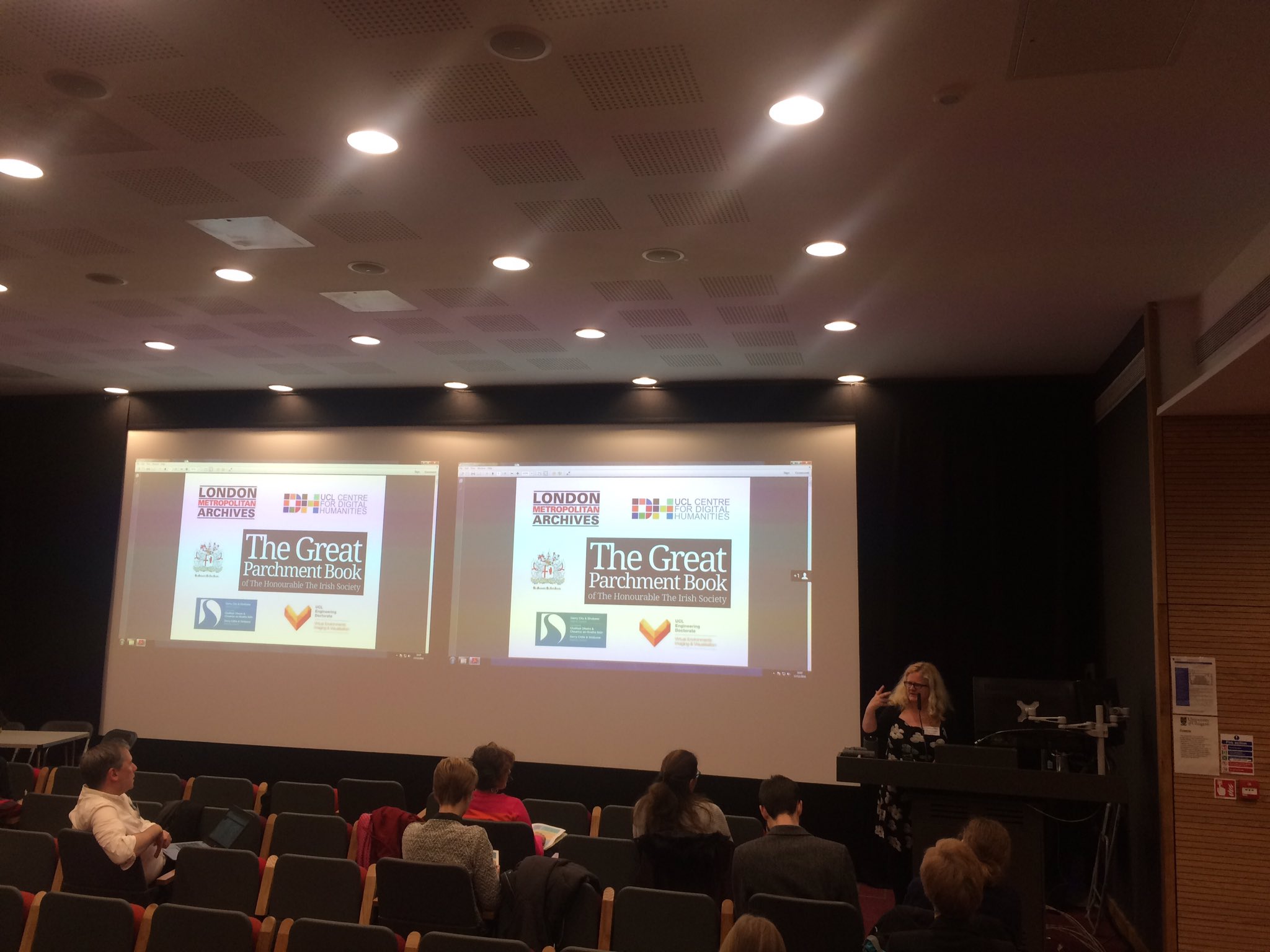
In a special lecture to mark the anniversary of the Honourable the Irish Society, historian Dr Ian Archer explores how the City of London came to be involved in the Irish plantations with this lecture marking the 400th anniversary of the Honourable The Irish Society.

Lecture: London-Derry Connections: The early years, 1613-1640
Wednesday 26 June 2013 6.00pm
Venue: Guildhall Old Library

Admission Free, but reservations required: enquiries@gresham.ac.uk or 020 7831 0575.

This event is part of the City of London Festival. For more information visit the City of London Festival website.

Irish Society visit exhibition

Posted on

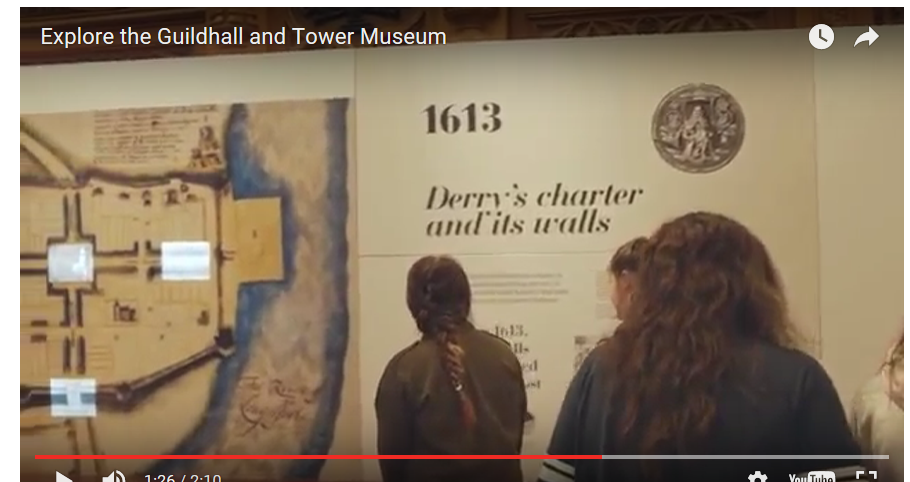
There were over 1100 visitors to Derry Guildhall exhibition Plantation: Process, people, perspectives on its opening day, Monday 10 June, including members of the Irish Society Advisory Committee. Bernadette Walsh says that the feedback received so far has been very supportive and encouraging. She has sent some photographs of the Irish Society visit which you can see here.

©/Lorcan Doherty Photography June 10th 2013.

Irish Society visit to Derry Guildhall

©/Lorcan Doherty Photography June 10th 2013. Mandatory Credit Lorcan Doherty

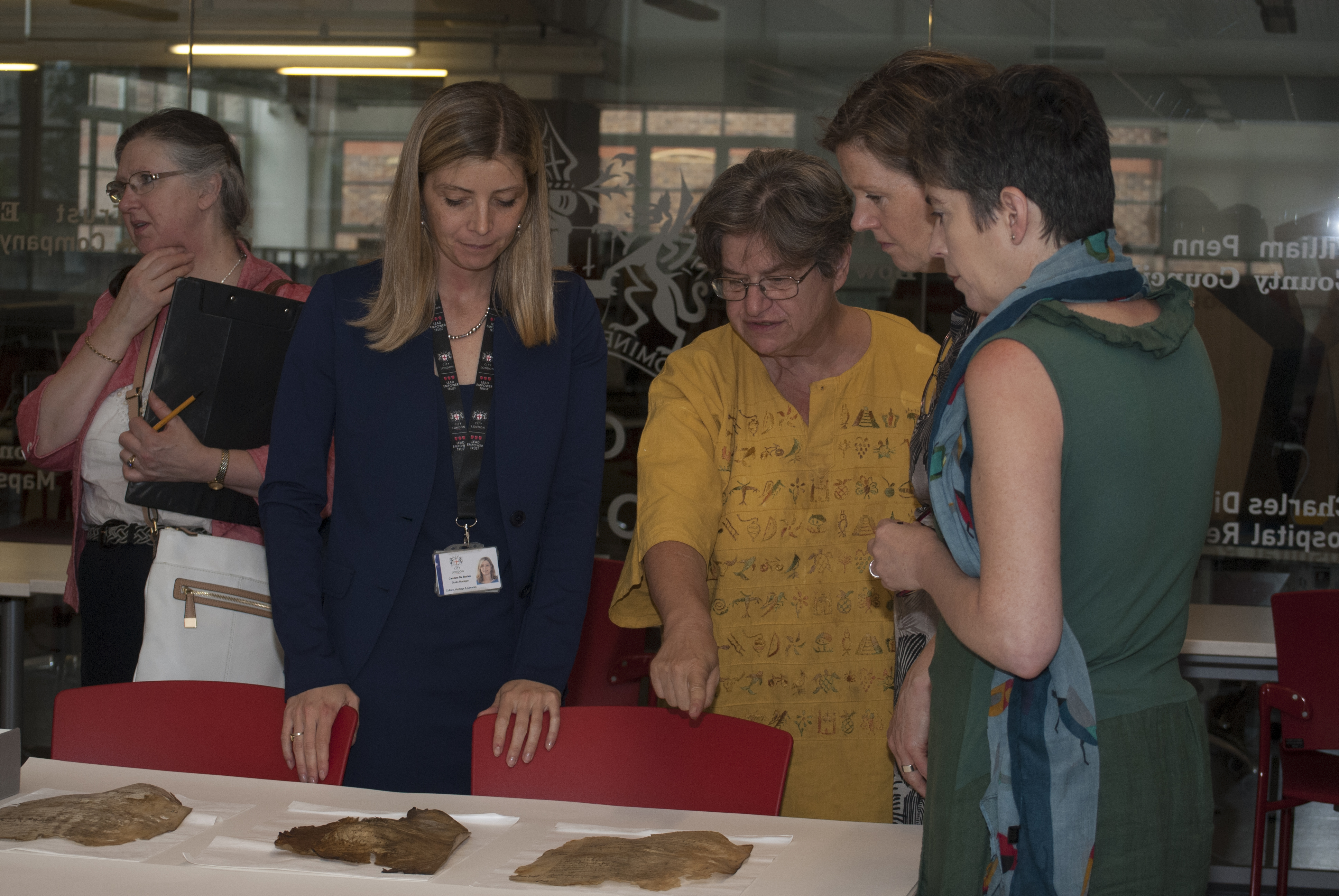
Bernadette Walsh showing the original folio of the Great Parchment Book in the exhibition to the Mayor of Derry and a Governor of the Irish Society.


Derry Guildhall exhibition opens today (10 June)

Posted on

Bernadette Walsh keeps us up to date with developments at Derry Guildhall: The Guildhall exhibition – Plantation: Process, people, perspectives – opens to the public on Monday 10 June at 10am.  It’s a very exciting time for all the staff involved in researching, developing and installing the exhibition.  We have a range of archives and objects installed, from original maps to Sir Cahir O’Doherty swords, and the star of the show – a page of the Great Parchment Book. We have monitored the environment, checked the audio-visuals and hung the dressing up clothes and we are ready for the visitors… we hope!
 
Coincidentally, we have a visit by the Irish Society to the Guildhall on Monday, so current members will be one of the first to see the archives on display on loan from London Metropolitan Archives.
 
It’s been a long road: I believe we began talking about an exhibition in 2007, as we were commemorating the Flight of the Earls. Good luck to everyone!

THE GREAT PARCHMENT BOOK WEBSITE HAS GONE LIVE!

Posted on

You can now start to explore the Great Parchment Book for yourself.

A good place to start is the video on the Home Page which illustrates the challenging nature of the project.

To continue your exploration, click on “Take a look inside the book” or search for a person, place or livery company.

If you want to know more about the historical background, book or project history, investigate the history tabs at the top of the Home Page.

The website is dynamic. Work is continuing on the transcription, and transcriptions and images will continue to be added to the site. Once the transcription is complete, the book history page will be expanded to take account of new insights into the codicology of the book, and to explain the arrangement of the folios.

The Great Parchment Book Blog is now embedded into the website and you can subscribe to the Blog on the website. Work is continuing to align the original Blog and the website Blog.

If you have any comments on the website, or can offer additional insights into the Great Parchment Book and what it reveals about the people, places and organisations involved in the history of 17th century Ulster, please share via the Blog or use the comment form at the bottom of the website Home Page.

The Guildhall exhibition: Plantation: People, Process, Perspectives

Posted on

Bernadette Walsh describes preparations during the week of 20 May 2013.

It was an exciting, if very stressful week, as I coordinated the final period of installation of objects and archives for the exhibition.  The exhibition includes a range of objects and archives from the Derry Heritage and Museum Service collection and from national collections in London, Limerick and Dublin.  It’s certainly not a traditional museum exhibition, with a variety of engaging activities and opportunities for all visitors alongside exhibition showcases.  Ever wanted to dress up as Cahir O’Doherty …. well now you can!

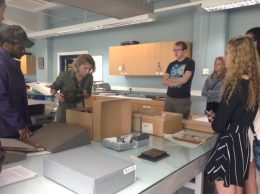
Staff from the London Metropolitan Archives and the National Archives Kew arrived in the city on Tuesday and installation began on Wednesday morning.  Anyone who has experience of installation will know how nervous it is not only for those travelling with rare and valuable objects but also for the loaning institute staff who are put to the test to ensure the showcases, environmental readings and general exhibition requirements can be met.  But all is well, despite some last minute hitches with stubborn archive drawers, additional mylar straps to ensure no movement of the archives, my colleagues from London worked patiently and diligently to ensure the archives were installed .… and look fantastic.

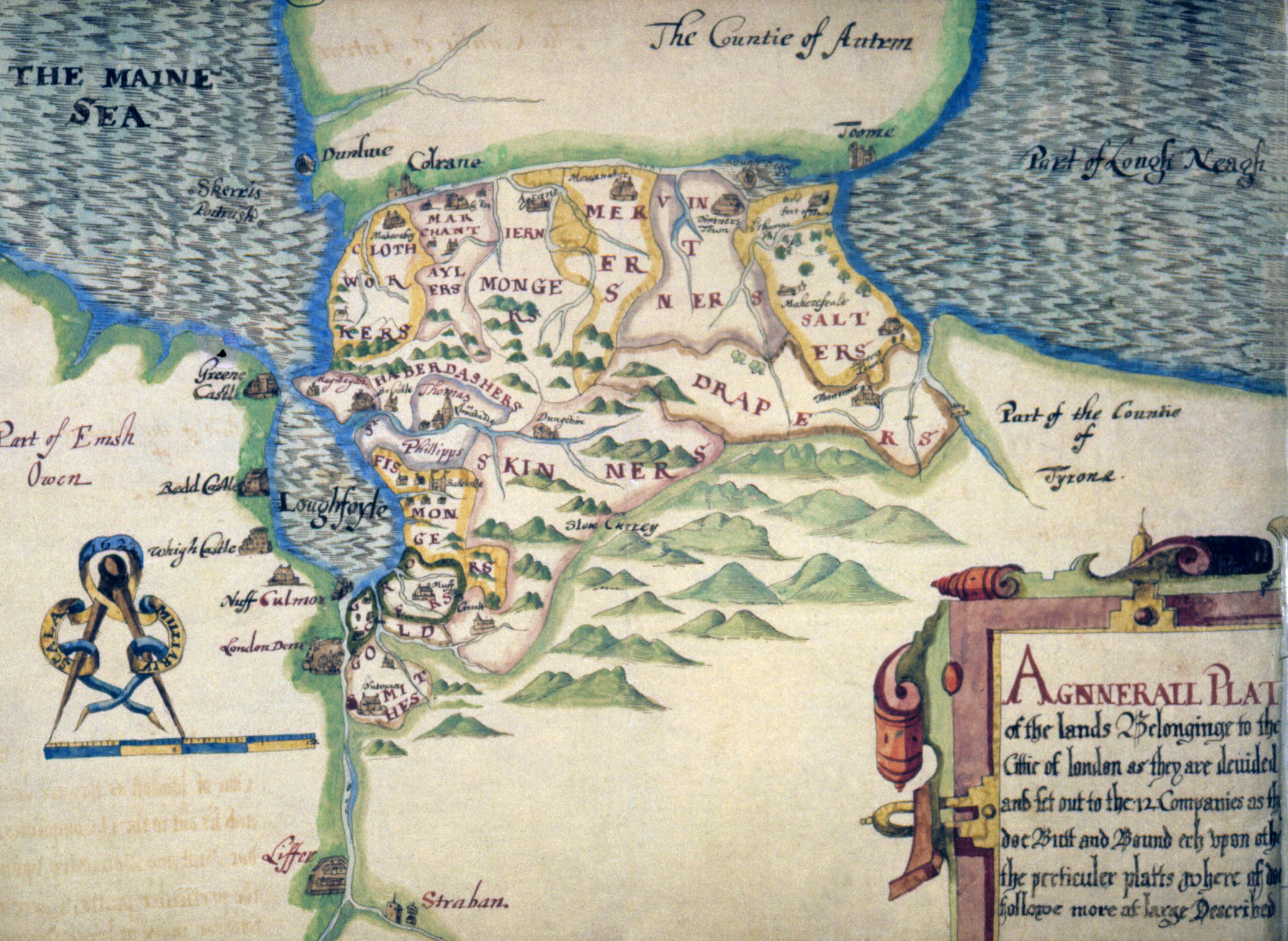
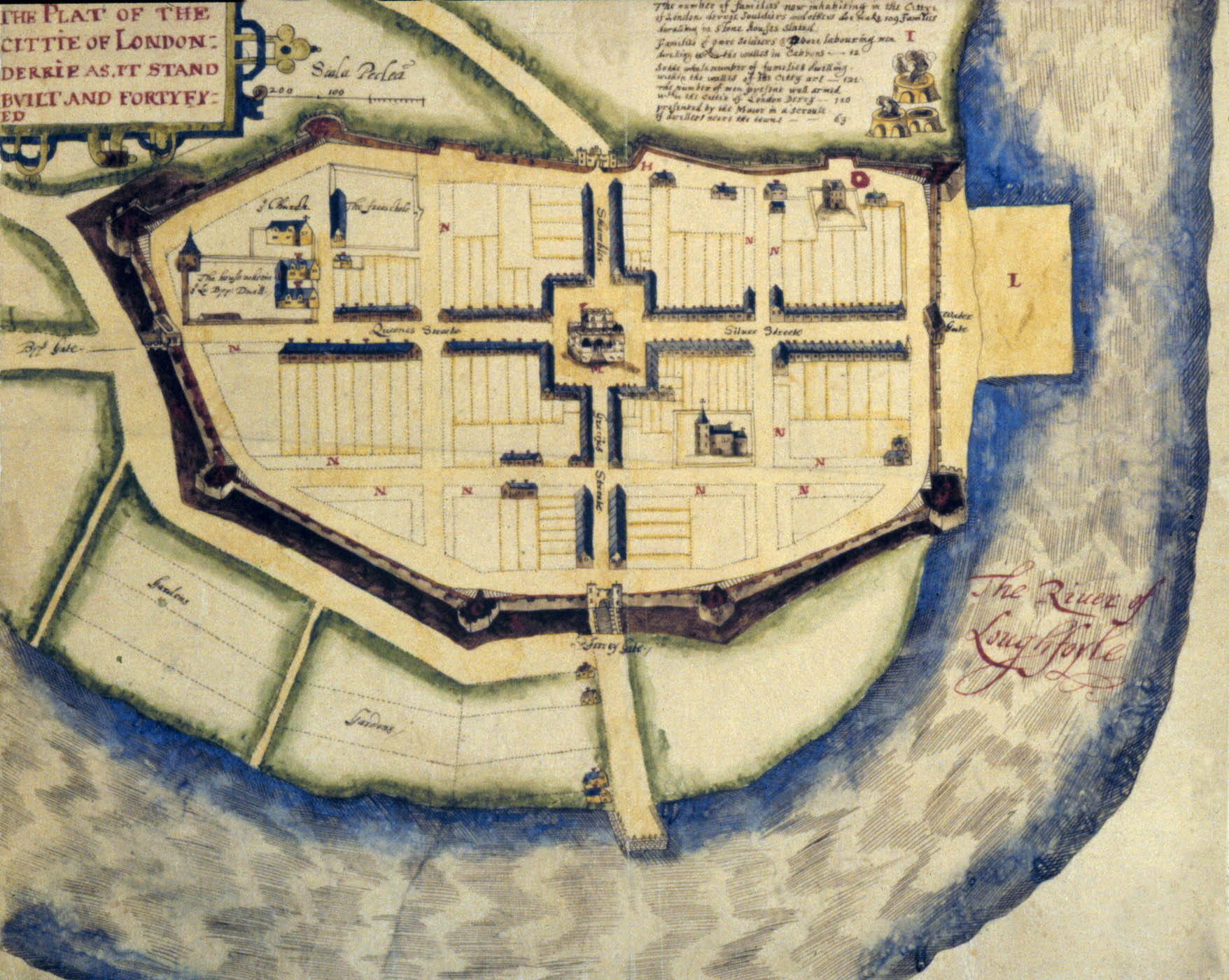
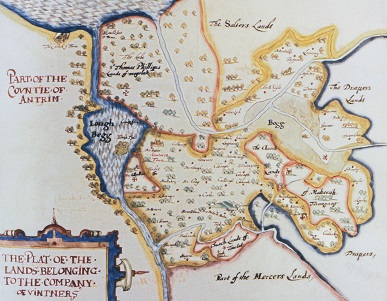
After reading and reviewing the Irish Society collection in the LMA and feeling like I know every line in those familiar early seventeenth century maps of the city it feels we achieved something significant as visitors to the exhibition will see them on display in the city where their journey began.

Next we have objects arriving from the Hunt Museum Limerick and from the National Museum of Ireland collection …… as well as a unique piece of textile art from artist Deborah Stockdale!

Exhibition at Derry’s Guildhall opening soon!

Posted on

Exhibition at Derry’s Guildhall – Plantation: Process, People, Perspectives

Opening in June 2013

Bernadette Walsh Archivist at Derry City Council’s Heritage and Museum’s Service writes:

After many months of researching archive and museum collections, wrestling with start and end dates, what themes to cover and the successful appointment of Museum Designers (Tandem) we now find ourselves just a few weeks away from the opening of the exhibition!

The exhibition will look at the Plantation, how it was planned, how people were effected and what is the legacy today. With Tandem we wanted to explore this particular period of history not only to learn and understand more about our conflicting past but to also allow visitors to the exhibition an opportunity to interact with some of the personalities and problems that developed. It is also an opportunity to showcase a fantastic collection of original maps, drawings and museum objects loaned by national institutions such as the London Metropolitan Archives, the National Archives UK and the National Museum of Ireland.

Plantation Society

Posted on

The charters in the GBP offer some fascinating insights into the different types of people who lived and held land in the county.  In each grant, the property-holder named is distinguished by their social status, office held, occupation, familial relationships, or a combination of these.  Many of those holding larger pieces of land in the Proportions – single and multiple townlands – were described according to social class: gentlemen, esquires, yeomen, and knights.  On the other hand, most of the people holding land in the town of Coleraine and the city of Londonderry were described according to their occupations: clerks, lawyers, carpenters, sailors, tailors, fellmongers, shoe-makers, glove-makers, innkeepers, barber-surgeons, butchers, brewers, cutlers, tanners, labourers, or according to their office, such as alderman, chamberlain, member of the privy council, or swordbearer.  Women, too, held property by these grants.  Although always described as widows or daughters, these women held land either under their own names or jointly with a man whose relationship to the woman is not often specified or clear.  Some properties are also held jointly by pairs or groups of men, sometimes fathers and sons, sometimes men with other links, such as a group of aldermen, yeomen, or husbandmen.  The names, too, give an indication of whether the land-holder was Irish, English, or Scottish.  While the ‘native’ Irish peasants were originally meant to be displaced and re-settled, the grants in the Book show that some Irish families, in particular the O’Cahans, were granted large amounts of land.
Freedom for the Lord Lieutenant of Ireland

Posted on

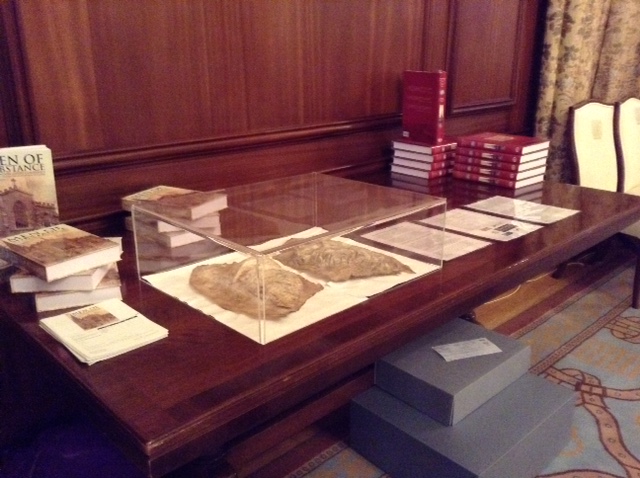
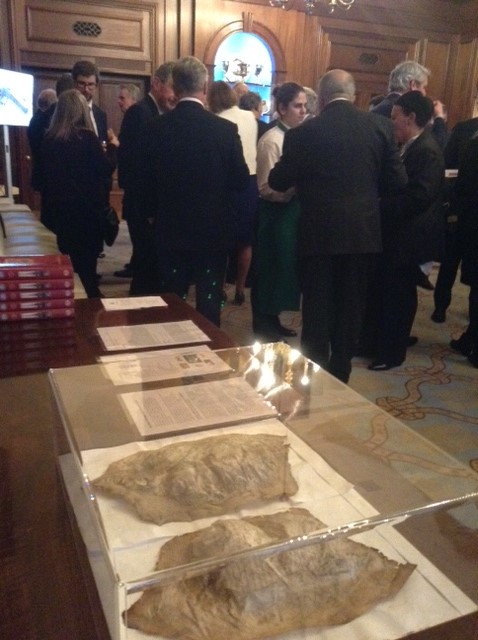
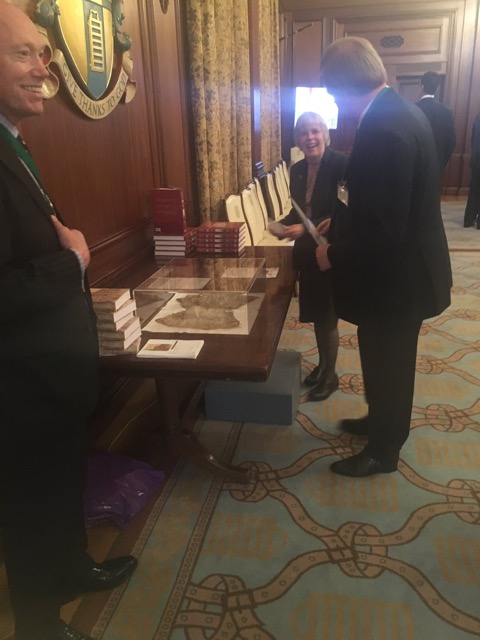
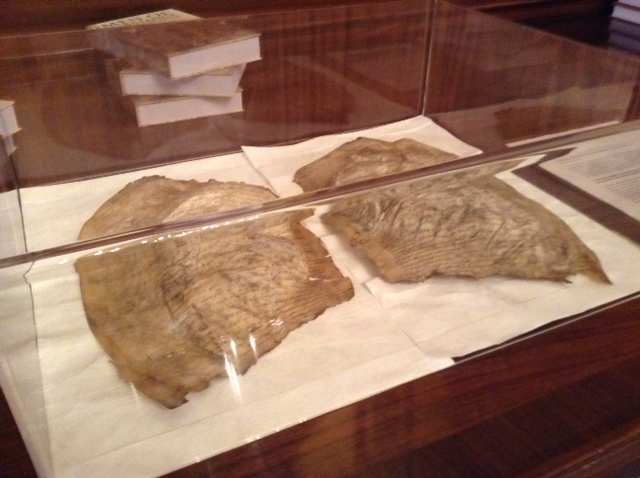
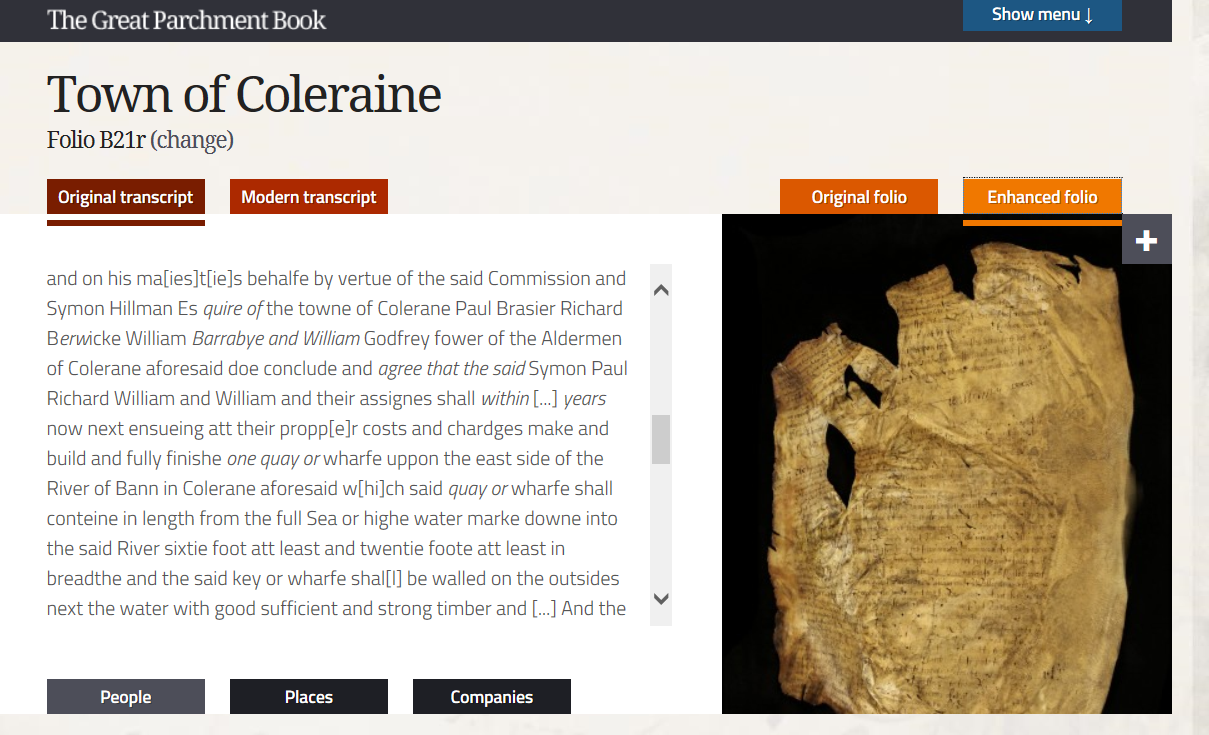
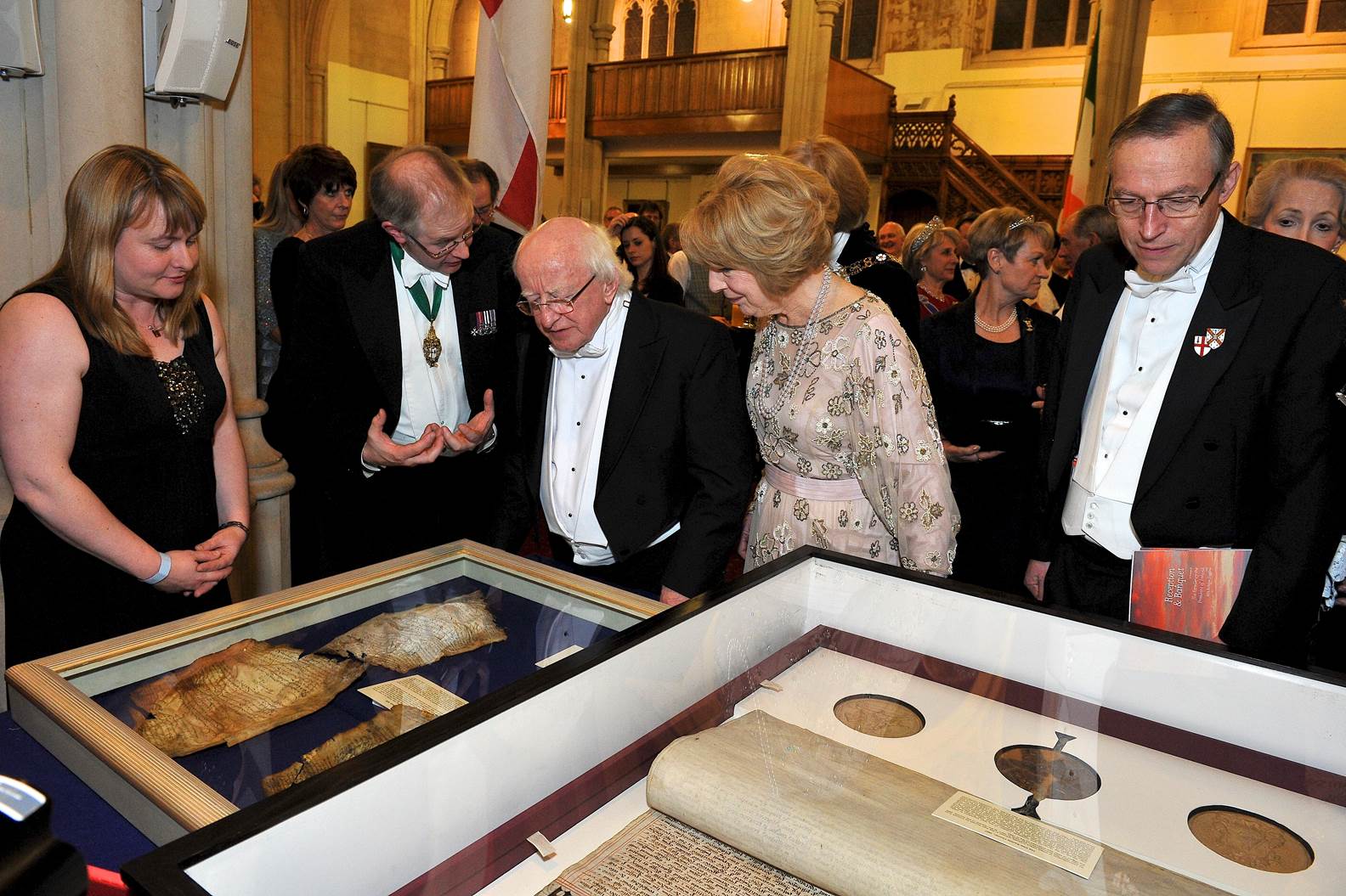
On 26th February, the Lord Lieutenant of the city of Derry, Sir Donal Keegan, was presented with the Freedom of the City of London.  At these occasions, historical objects that are connected to the City and to the recipient are featured, and in this case, a folio of the Great Parchment Book was on display.  This particular folio was from the section dealing with lands held in the city of Londonderry, and generated a great deal of interest in the project and the Great Parchment Book itself. The Great Parchment Book will also feature in the Plantation exhibition at the Derry Guildhall during the city’s 2013 celebrations as the City of Culture, for those who are in the area!

Sir Donal with the folio from the Great Parchment Book

Sir Donal with the folio from the Great Parchment Book

(L to R)  Catherine McGuinness and Richard Regan (Past Deputy Governors of The Irish Society), Sir Donal, Alderman Ian Luder (current Governor of The Irish Society)

(L to R) Catherine McGuinness and Richard Regan (Past Deputy Governors of The Irish Society), Sir Donal, Alderman Ian Luder (current Governor of The Irish Society)

(L to R) Murray Craig (Clerk of the Chamberlain’s Court), Sir Donal, Ernest Brocklehurst (Beadle to the Chamberlain

(L to R) Murray Craig (Clerk of the Chamberlain’s Court), Sir Donal, Ernest Brocklehurst (Beadle to the Chamberlain

Sir Donal with Paul Double (The Remembrancer)

Sir Donal with Paul Double (The Remembrancer)


Exploring and Flattening Parchments Interactively

Posted on

We recently had our paper, Interactive Exploration and Flattening of Deformed Historical Documents, accepted for publication in the Computer Graphics Forum and to be presented at Eurographics 2013.

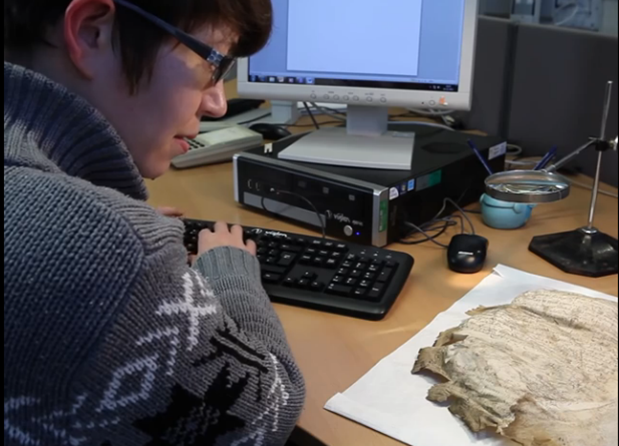
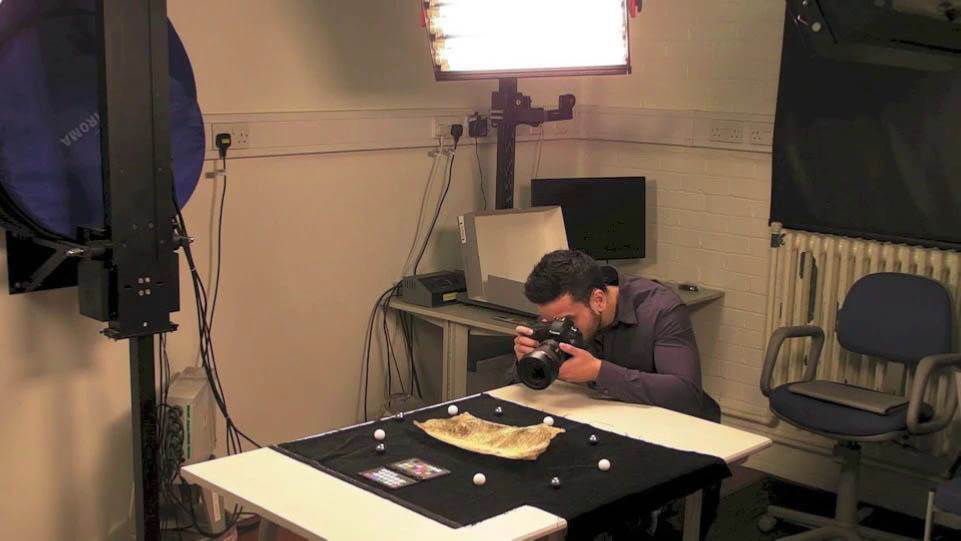
Our procedure begins by capturing a set of high resolution photographs of the pages of the book, and generating from them a detailed 3D scan of each page. Typically we need between 40 and 60 images per folio to capture every fold and crease in sufficient detail. Using these scans we attempt to “virtually restore” the pages and produce undistorted images of the pages.
Three pages of the Great Parchment Book. Top: our reconstructed surface model. Bottom: the models textured with images of the text. The surface models show the level of distortion the parchment has suffered, which differs greatly from folio to folio.

Three pages of the Great Parchment Book. Top: our reconstructed surface model. Bottom: the models textured with images of the text. The surface models show the level of distortion the parchment has suffered, which differs greatly from folio to folio.

Having generated scans for the majority of the pages in the book, we realized that producing a globally flattened and undistorted image of a page is not always possible for the more damaged pages due to the sheer variety and complexity of the deformations present.

To get around this problem we instead created an interactive browser application, effectively a “Google Earth for documents”. Google Earth allows users to navigate over the surface of the earth following lines of latitude and longitude, and always see a locally flat map of the region of the earth they are looking at. In a similar way, our viewer allows users to navigate over the surface of the page following lines of text, and see a locally undistorted image of the region of the page currently in view. One of the key insights here is that flattening multiple small, local regions of a page is much simpler than flattening the entire page at once.

Sections of text before and after the local flattening procedure

Sections of text before and after the local flattening procedure

We also understand the importance in the digital cultural heritage field of being able to trust digital representations of artifacts. To help users gauge the quality of the reconstruction and be more confident in what they read, our application includes a “provenance feature” which allows them to compare the 3D scan and the original photographs which were used to generate the scan. For every point on the scan surface, the application can display an original input photograph next to it which allows the user to verify what they are seeing in the scan.

Left: A region of a reconstruction of a page, containing a suspect marking which looks like it might have been introduced by an error in the reconstruction process. Right: One of the original photographs, looking at the same region of the page. We can see that the marking is in fact present on the page.

Left: A region of a reconstruction of a page, containing a suspect marking which looks like it might have been introduced by an error in the reconstruction process. Right: One of the original photographs, looking at the same region of the page. We can see that the marking is in fact present on the page.

Our application will soon be used as an additional tool for the transcription of the Great Parchment Book and possibly later as a means of dissemination of the book’s content.

Landholdings

Posted on

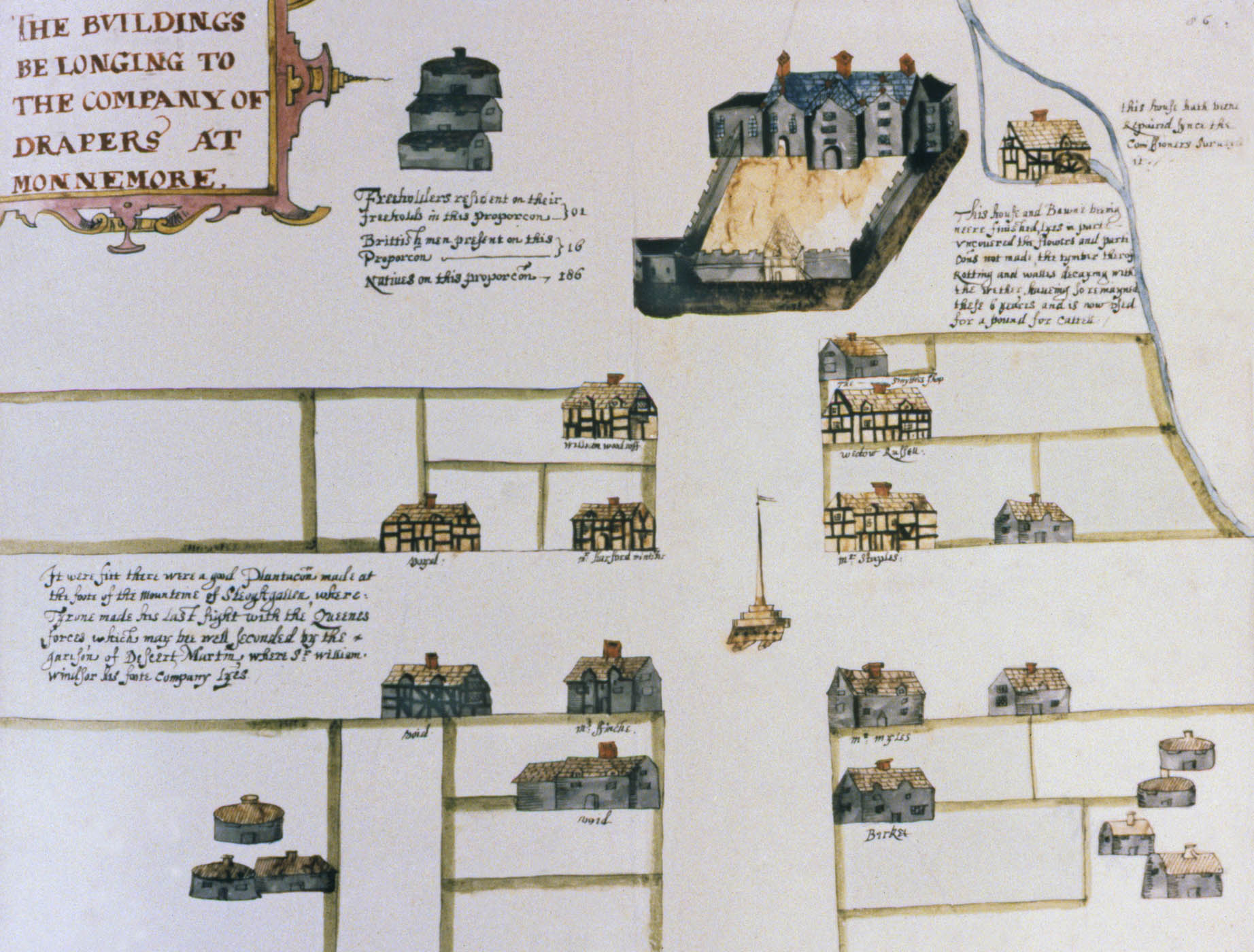
As the transcription of the Great Parchment Book continues, a range of types of landholdings is becoming apparent.  The charters in the Book are largely grouped  according to the Livery Company holding the land, but there are also sections for lands held in the city of Londonderry and the town of Coleraine, and for those lands held by the ‘native’ Irish. These charters grant a variety of holdings, ranging from ‘smale parcalls’ measured in perches to urban tenements to townlands covering hundreds of acres.  Although there is reference to specific parishes, albeit the use of the term ‘parish’ is rare, and to churches, vicarages, and chapels in a more general sense, so far there has been no mention of lands granted to any church, nor has anyone been instructed to build or maintain any churches.

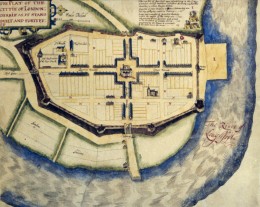
Those properties held in the city of Londonderry and the town of Coleraine are often specified as being on a specific street. Londonderry had four main streets: Gracious Street, Queens Street/Bishopsgate Street, Silver Street, and Shambles Street. This last was also known as Butchers Street or Butchers Row as the term ‘shambles’ refers to either stalls to sell meat or a place to slaughter animals.  At least one butcher, James O’Gallagher, is recorded with a holding on Butchers Street, however, the only slaughter-house mentioned is found on Gracious Street and belonged to a cutler called John Knox. 

The properties in Londonderry and Coleraine were not strictly urban, since they also included a ‘backside’ or back-yard and garden of unspecified size, and often a piece of land in the Liberties of Londonderry or Coleraine, or in the Island of Derry.  The Island of Derry refers to the hill upon which Londonderry is located, surrounded by the River Foyle and an area known as ‘The Bog’ which was at one time under water but had become marshy and silted up by the seventeenth century.  The Liberties of Londonderry and Coleraine extended for a distance of three miles on all sides, and some of the holdings located in these areas were much larger, up to a few hundred acres.

The largest holdings, however, are found in the Proportions held by the various Livery Companies.  Each Proportion was divided into townlands which varied in size. The majority of the landholders were granted a single townland, but a number held multiple townlands comprising, sometimes, thousands of acres.

Puzzling Place Names

Posted on

The Great Parchment Book contains many types of places used in different contexts. Land in Northern Ireland was divided into counties, parishes, and townlands of varying sizes, and it is the townland designation that is largely used in the Great Parchment Book to describe which pieces of land are held.  However, there are also other sorts of places named including estates, manors, castles, towns, streets, mountains, bogs, rivers… Once the place names have been transcribed – and they are not always obvious, especially when part of the name is missing or illegible – we have to decide what ‘type’ of a place it is and then identify the modern equivalent if possible since anyone searching for a specific place will use the modern terminology. Of course, there is also no guarantee that both the current and the Great Parchment Book place names refer to the same place. For example, folio G2v mentions the two townlands of ‘Lismakerell Bogge and Lismakerell Moore’ but there is currently only one townland called Lismacarol. In addition, the name as found in the Great Parchment Book may not exactly match modern place names and some deciphering may be necessary: Tarquiny vs Tirkeeveny; Moymucklemurray vs Moy mc Gillwory; Mullagh vs Meola. Some of the place names are used to identify landholders, such as William Wray of the city of Dublin; Radcliffe Kirk of Blessingbourne in the county of Tyrone; and Edward Hill of Farsetmore in the county of Donegal. Helpfully, Dublin, Tyron, and Donegal have been specified a bit further, and a quick search on the internet reveals that Blessingbourne refers to an estate and Farsetmore is a townland.  However, some names refer to many types of places. Coleraine is a town, a parish, and a townland, while Londonderry is a county and a city, and these are not always specified. One can only hope that the writers of the book knew which places they were talking about!

Beginning the transcription

Posted on

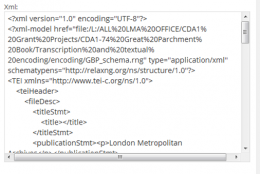
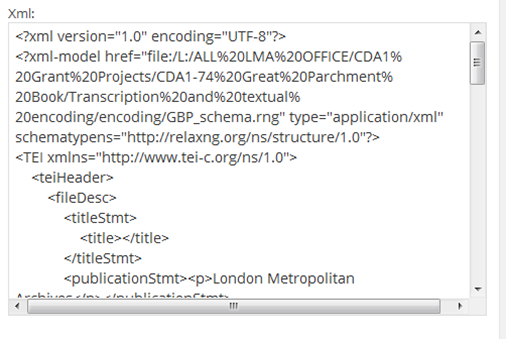
Now that the conservation work is completed, we have begun the transcription and encoding of the folios. We are beginning with the six folios on the Goldsmiths’ proportion and will use these to plan out the website and the particulars of the encoding into XML using TEI. But first they have to be transcribed!

The text itself is formulaic, which means that it is usually possible to fill in the text missing from those areas that are illegible, burnt, shrunken, torn, or covered in dirt. This also means that the transcription involves much rereading of the folios to fill in the gaps, but it is very satisfying to have a complete transcription.

Whilst the text itself is in English, there are lots of varieties in the spelling (for example, the use of ‘howse’, ‘fower’, ‘cabbyns’) so we are going to include a modernised transcription on the website, with modernised spelling, punctuation, and names (as far as is possible). We also plan for the website to include a glossary of terms that may be unknown or not immediately obvious to the reader, such as ‘quicksett’ and ‘fireboot’. The place names present extra challenges as some of the names mentioned correspond to current Northern Irish place names, but some of them do not. In addition, there is no guarantee that the 1639 boundaries of places such as townlands and counties correspond to the modern ones. Fortunately, the script itself is a large, neat, clear, secretary hand, and this makes the transcription a little easier.

post17Pic01

post17Pic02


Open studio event at LMA – Behind the Scenes in Conservation

Posted on

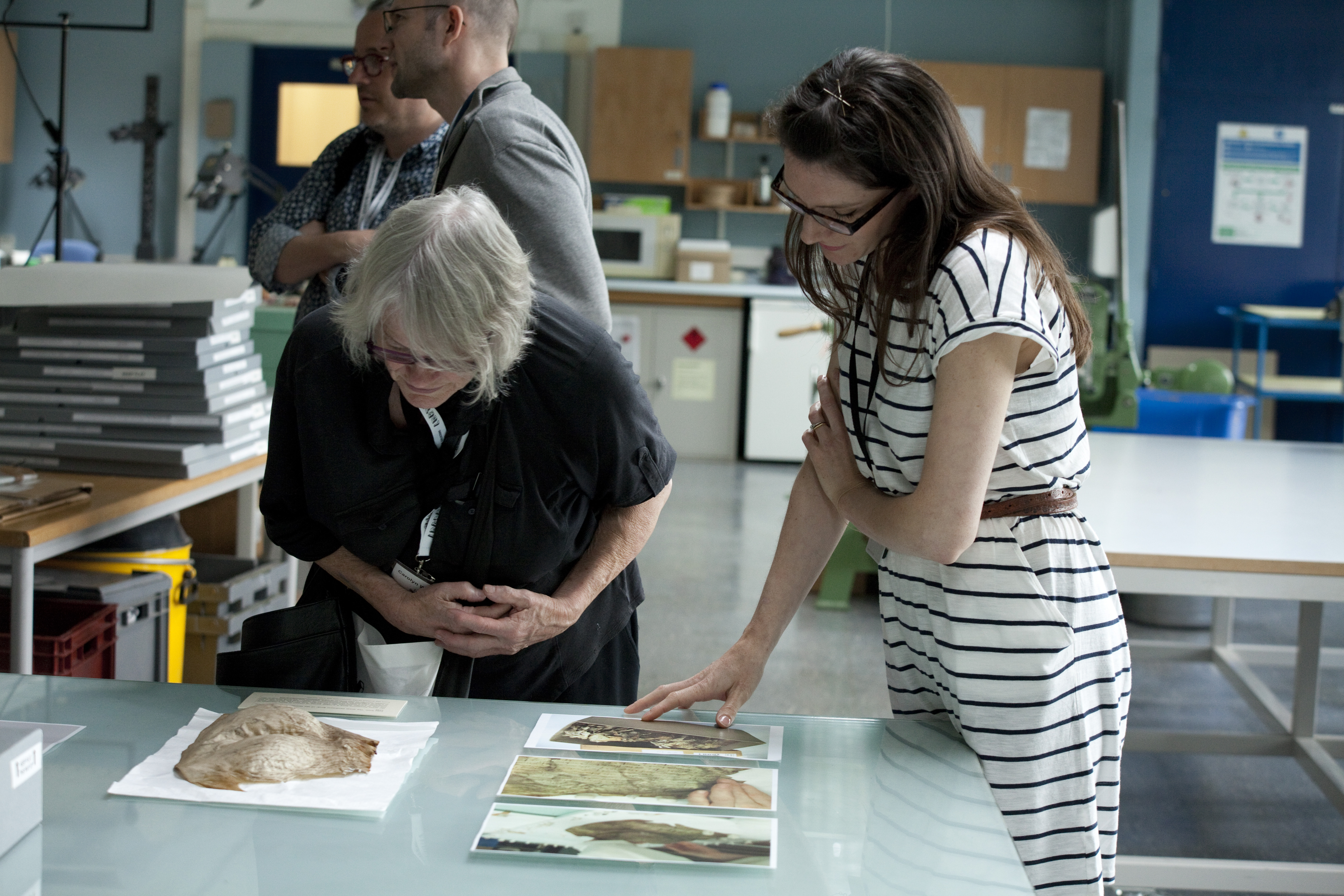
Next Tuesday 20th November we will have an open studio day. This is an opportunity to come and see the repaired and housed Great Parchment Book. Rachael will show you the techniques she has used to humidify, tension dry and repaired the parchment.

Just come to London Metropolitan Archives between 10 and 12 or 14 and 16. To find out more please click here. See you soon!

Great Parchment Book membranes

Repackaging

Posted on

Once all the sheets had been treated, they just needed rehousing. The sheets could not be put back into their original boxes because they were no longer suitable in terms of their size and shape. Also, it was felt that the boxes were housing too many sheets to a box.

For ease of handling, it was decided that the sheets should be stored in Clamshell style boxes with, on average, six to a box. The sheets would also need to be interleaved to stop them catching on each other. The interleaving material needed to be something thin and flexible that would mould to the shape of the sheets, so reducing the risk of extra bulk, but also smooth surfaced so the sheets won’t catch on it. It will also act as a support for each sheet when moving them in and out of the boxes.

Tyvek® was chosen for the job as it fits all these qualities and is chemically inert.

Lifting the membranes

Repackaged

Repairing the membranes

Posted on

There are fragments from some of the sheets that have been found at the bottom of the boxes. Some of these have already been matched up to certain sheets and numbered; some still need to be matched up. Gelatine coated tissue is used to hold these loose fragments in place.

Attaching gelatine coated tissue splints

Attaching gelatine coated tissue splints

Treatment on the Great Parchment Book

Posted on

Part 3

Tension drying

Magnet drying is proving to be the most effective method for holding out the creases whilst drying. Metal sheets are wrapped in thin blotter and covered with thin non-woven polyester (which reduces the risk of the parchment sticking). Magnets wrapped in felt or Tyvek® are used to hold open creases whilst the parchment dries. It was found fairly early on that the amount of shrinking present on some of the sheets was preventing the creases from being pulled out horizontally. This was remedied by inserting polyester wadding underneath the creased area and so pushing it out in a vertical direction, as well as pulling horizontally with the magnets.

Magnet set up

The edges of the parchment are held down with magnets

The edges of the parchment are held down with magnets

Tears can also be secured with magnets

Tears can also be secured with magnets

Treatment on the Great Parchment Book

Posted on

Part 2

Testing of inks

Prior to humidification, the Inks were tested for solubility in water and also for the presence of any metals within the ink. The inks were found non-soluble in water and, for the most part, no presence of metals was detected.

Humidification

The sheets of parchment are placed in a humidification ‘sandwich’, where they are layered up with Gore-Tex® and damp blotter (see diagram below) and left to gently humidify for approximately six hours.

Cross section of humidification set-up

Cross section of humidification set-up

Small ‘humidity packs’, made by wrapping Laponite® (a synthetic layered silicate) in thin non-woven polyester and then Tyvek® (a brand of flash spun high-density polyethylene fibres), can be placed in the sandwich over the shrunken areas to increase the humidity reaching these areas and therefore increase the softening.

Humidity packs placed over shrunken areas

Humidity packs placed over shrunken areas

Treatment on the Great Parchment Book

Posted on

Part 1

With all the tests we have carried out we are now ready to start to work on the Great Parchment Book!

Surface cleaning

Prior to humidification surface cleaning is being carried out using vulcanised rubber sponges and soft goat hair brushes. The sponge works by picking up and drawing in the dirt when it is placed in contact with the surface of the object to be cleaned. With the Great Parchment Book, ideally, we would like to remove as much surface dirt as possible from the parchment to stop it being drawn into the substrate when it absorbs moisture during humidification. Also, it helps to improve the legibility of the text. However, where flaky media is present, surface cleaning has to be avoided as the sponge will pick this up too.

Area before cleaning

Area before cleaning

Area after cleaning

Area after cleaning

The ink on the sample above is very stable and so the area could be cleaned. The sponge was most effective on the area in the middle, where the dirt was sitting loosely on the surface. However, the dirt in the bottom right hand corner of this image was much more ingrained, and so surface cleaning did not improve it.

Treatment trials continued… (part IV)

Posted on

17th-century samples with original fire damage

An original sample of heat damaged parchment (not part of the LMA collection) was found, and the magnet drying system was tested again. This was a good sample to test the treatment on as it had similar planar distortions and fragile edges as seen on the Great Parchment Book, which would not withstand having clips attached. (The sample was fully humidified between blotter and Gore-Tex®.)

Before treatment

Before

After treatment

After

Close-up before

Close-up before

Close-up after

Close-up after

Results

This method worked really well. Stronger, larger magnets were used around the shrunken areas to help hold the creases open, and then weaker, smaller ones were used to hold down the torn, fragile edges. However some tears, that were already present, did become wider and more obvious. This was a natural reaction to the overall plane of the parchment becoming flatter, but should be avoided when treating the Great Parchment Book.

Virtual flattening

Posted on

Alongside all the conventional conservation work happening on the book, here at UCL we are experimenting with ways to “virtually restore” the book using a mix of imaging, computer vision, and computer graphics techniques.

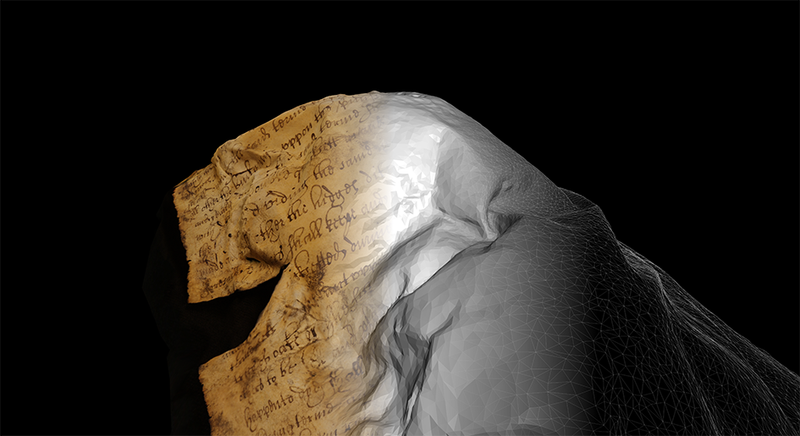
Our approach is two-fold. First create a virtual 3D model of each page, and second flatten the 3D model into a 2D plane. It sounds fairly simple but is deceptively complex.

Creating detailed models of the pages requires a careful imaging process to try to get inside every crease and fold and capture every letter at as high a resolution as possible. The result is a set of 50 or so high-resolution images (for each page of the book). These are fed into a pipeline of computer programmes which (after a considerable amount of processing time) generates the 3D model.

Before flattening

Before virtual flattening

3D mesh

3D mesh

Then comes the problem of flattening the page in a sensible way. At first glance, it would seem that we want to just “unfold” the page as you would a crumpled piece of paper. However, the way the pages are distorted is not like crumpling a piece of paper and so there is no nice and easy way to “unfold” them. So now the problem becomes “how can we flatten the page into a 2D plane in such a way that the text does not become distorted”, and that is what we are trying to solve at the moment.

After flattening

After virtual flattening

Treatment trials continued… (part III)

Posted on

RESULTS – PEGGING

Before treatment

Before

Peg drying

Peg drying

After treatment

After

The peg method was quite successful in reducing the planar distortion on the fully humidified sample. The pins were put straight through the ends of the pegs, meaning the parchment was held very taught with not much room for movement. If using this method on the Great Parchment Book, which is much more fragile, we would want to allow for more movement to prevent tearing. Therefore elastic bands would be attached to the pegs and the pins put through these to allow for more flexibility.

Close-up before treatment

Close-up before

Close-up after treatment

Close-up after

Treatment trials continued… (part II)

Posted on

RESULTS – SUCTION TABLE

Before treatment

Before

Suction table drying

Suction table drying

After treatment

After

It was found that with both local and complete humidification, suction table drying was not appropriate. It did flatten out the sheet, but pulled smaller creases in more deeply. This method would be more effective on items that were less badly damaged, without shrunken areas, and that could be humidified to a greater extent.

Close-up before

Close-up before

Close-up after

Close-up after

Treatment trials continued…

Posted on

19th-century, artificially damaged parchment

A large manuscript, parchment document (not part of the LMA collections) was cut down into 16 small rectangles (180 x 140mm), which were then folded and sewn together to make a replica book. Successful shrinking was achieved through baking the book in a conventional oven and introducing moisture at regular intervals. The temperature was 200°C, and the book was left in the oven for 20 minutes with mill board clamped around it, then for another 10 with no mill board. The best shrinking was achieved by spraying the pages with water whilst it was in the oven.

post8Fig1

The book was dis-bound and six folios chosen which seemed to have damage similar to that seen on the Great Parchment Book. Local humidification and full humidification combined with peg drying, suction drying and magnet drying was tested on the sheets. The results for those that were fully humidified can be seen below.

Results – magnets

Before treatment

Before

Magnet drying

Magnet drying

After treatment

After

This method was very successful, in terms of reducing the planar distortions. The only concern was that it might damage flaky media, and so an extra barrier, between the magnets and parchment might be needed. This method would be very good for badly torn sheets with areas too fragile to withstand having a clip or peg attached.

Close-up before

Close-up before

Close-up after

Close-up after

Treatment trials

Posted on

Creased new parchment

Twelve samples of new parchment, which had been scrunched up and creases folded in, were tested to compare plain water against a water/ethanol solution, local humidification against full humidification, and different tension controlled drying methods (suction table, pegging out and magnets).

The three drying techniques:

1. For the suction table method, samples were placed onto the suction table, with thick blotter underneath, and the creases gradually eased out.Suction table
2. For the pegging method, plastic clips (with rubber and thick non-woven polyester between their jaws) were attached to the edges of the samples, and then put under tension and pinned in place on a soft board.Pegged samples
3. For the magnet method, a metal sheet was covered in thick non-woven polyester, the samples placed on top, then small magnets covered in felt arranged on top to hold them flat.Magnets

Results

Humidification

In comparing the use of water and a water/ethanol solution to humidify the samples, it was found that there was little difference. After 1.5 hours, all samples were equally soft and ready for drying. The only main difference was that the samples that had been fully humidified with just water tended to curl up. Also with these samples it was difficult to see much difference between samples that had been partially humidified and those that had been fully humidified.

Tension drying

All the tension drying methods were quite successful with all the samples, which was to be expected for new parchment. With the magnets, difficulties might occur when applying the magnets to older, distorted samples with wavy edges if the parchment was only locally humidified. In this instance the edges would be quite hard and so susceptible to damage from the pressure of the magnets. This would also be a problem with the pegging out method too. The next stage will be to test these tension drying methods on samples of distorted parchment to see how appropriate they will be for use on the Great Parchment Book.

Deciding on treatments to trial for potential use

Posted on

When deciding on potential treatments it is important to consider the main aims and outcomes that are sought.

For this project, these are:

  • To remove creases so that hidden text is visible and can be photographed
  • To consolidate flaky media
  • To repackage sheets for safe storage
  • To use techniques that are ethical and involve minimal intervention

Solvents for humidification

To achieve the first goal, humidification will be necessary and so we have to decide which solvents will be used for this. The main ones in use are water and water/ethanol solutions which work by the vapours penetrating between the fibres and improving hydration. Latest research findings suggest that any use of either can have a detrimental effect on parchment fibres, but the extent of this is dependent on the type of fibre and its condition. Water and a water/ethanol solution will therefore be tested on samples for their effectiveness as humidification agents.

Amount of humidification necessary

Minimal intervention is critical and so it should be tested to see if just partial humidification of the worst areas is adequate for opening creases, or if full humidification is required. For partial humidification, the samples will be put in a damp blotter/Gore-Tex sandwich, interleaved with polyester to protect areas that are not to be humidified. The samples that are to be fully humidified will be placed on top of damp blotter and Gore-Tex in a covered tray.

Methods for tension drying

Magnets

The item is pinned out onto a metal sheet with magnets placed on the surface. This is an appropriate option for the GPB as it has pages with very torn, fragile edges. However, it is important to be aware of the strength of the magnets being used. Also, they can be quite brittle and can leave marks on parchment, so should be wrapped in a protective material such as felt or thick non-woven polyester.

Pegging out

Pegs (or bull dog clips) are attached to the item edges and then tensioned out with pins. This method is appropriate for some of the less fragile pages of the GPB as the pegs can cause further damage to fragile edges.

Suction table

The item is held flat on the table while it dries. This could be an option, but might not be very effective on parchment that has areas that are very distorted and stiff, which the GPB has, as it relies on good contact with the table to allow flattening.

Pressing under boards

The item is placed under boards with weight on top. Given the amount of planar distortion in the GPB, this method would be totally inappropriate – creases would be pushed further into the parchment rather than pulled out. Also, problems have been seen in the past with this method causing the parchment to become transparent.

The next three posts will give details of trials to be carried out for humidification and crease reduction on three types of parchment. The first type is deliberately creased pieces of new parchment; the second is 19th century parchment, which will be deliberately heat damaged to replicate that seen on the GPB; the third is 17th century parchment with old heat damage caused by fire.

Previous conservation treatments: learning from the past

Posted on

Twenty-one of the sheets have had previous conservation treatment, for which there is no documentation of when the work was carried out, by whom, or what was done. However, we can get a few clues from the condition of the sheets.

Previously treated sheet showing transparency.

Previously treated sheet showing transparency.

The sheets still have some degree of planar distortion but are generally much flatter. Gelatinisation in some areas has also worsened.

Less planar distortion.

Less planar distortion.

Complete gelatinisation in some areas.

Complete gelatinisation in some areas.

Each sheet has a layer of adhesive on the surface and a mesh like pattern imprinted into it.

Mesh pattern in surface of parchment.

Mesh pattern in surface of parchment.

A fairly standard method used in the past for drying parchment under tension, was to paste it out with an adhesive (most likely wheat starch paste) onto Terylene (or a similar fabric) and leave it to air dry. This is the method that seems to have been used here. It seems likely that having been pasted out onto the Terylene, the sheets were then also pressed with a board with some weight on top. This can be seen through the combination of the transparency of much of the parchment, the imprint of the Terylene weave into the surface, and in some cases some very deep, but very flat creases.

Pressed creases.

Pressed creases.

Compared to the untreated sheets this sheet shows more gelatinisation, which is probably caused by the treatment that was carried out. This previous intervention has led to further denaturing of the parchment with an increase in gelatinisation. The parchment is physically less stable now than it was before treatment.

Damage ratings

Posted on

These are some of the results we have collected:
Each sheet could be assigned a number depending on the extent of the creasing present; if there were creases but no text obscured it was C1, if there were creases which obscured one area of text it was C2, and if there were creases that obscured more than one area of text it was C3.

Only 13% of the sheets were rated as C1, so in no need of treatment. The other 87% of the sheets were designated as having at least one area of text obscured, so a C2 or C3 rating, and 74% of these were rated as C3. These crease ratings can be viewed alongside an overall damage rating for each sheet of 1, 2 or 3 (1 being slightly damaged, 2 being damaged and 3 being heavily damaged). All sheets were rated at either 2 or 3.

Damage rating 2 Damage rating 3
C2 21 (13%) 16 (10%)
C3 30 (18%) 78 (47%)

So, just under half of all the sheets are heavily damaged with more than one area of text being obscured by a crease. These sheets will be the most challenging to treat.

C2 rating 2

C2 rating 2

C2 rating 3

C2 rating 3

C3 rating 2

C3 rating 2

C3 rating 3

C3 rating 3

Condition Assessment

Posted on

The first thing Rachael did was to define the types of damage present in the parchment sheets and to determine the grade of deterioration. The fire and water have almost destroyed the book and the sheets left are badly damaged. The different types of damage and extent of each are recorded.

The most obvious one present in all the sheets is the planar distortion of the surface. Some of the creases are so stiff (due to the heavy gelatinisation) that it will be impossible to flatten them to any better degree.

These distortions are also caused by the heat of the fire which has shrunk the parchment. As a reference, we have taken a picture of a letter P present in the same area as another P. The only difference is that one P on the parchment was affected by the heat at a different grade than the other P, where the parchment has shrunk and is less than half its original size!

Two letters P of different size due to parchment reaction to heat

Two letters P of different size due to parchment reaction to heat

Creases and tears are found in various areas, mostly on the edges of the sheet.

Creases and tears are present in most of the parchment sheets.

Creases and tears are present in most of the parchment sheets.

Some sheets have calcite on the surface; this is a typical degradation product of parchment that has been subjected to moisture and high temperatures. Calcite is present within the structure of the parchment, but, under these conditions, migrates to the surface.

The white powder on the surface of the sheet is calcite.

The white powder on the surface of the sheet is calcite.

Another type of damage is severe gelatinisation. Gelatinisation is a degradation process catalysed by high temperature in which the collagen changes its structure irreversibly (denaturation). We have rated the damage in terms of severity at G1, G2 or G3. All of the gelatinisation recorded was rated G2 (full glass layer) or G3 (full penetration of parchment- transparent).

Gelatinisation rating G2: the parchment has stiffened and started to become translucent.

Gelatinisation rating G2: the parchment has stiffened and started to become translucent.

Gelatinisation rating G3: the parchment has deteriorated into pure gelatine.

Gelatinisation rating G3: the parchment has deteriorated into pure gelatine.

There are some areas where the parchment is so curled that the text is hidden between the folds.

Folded and curled parchment is hiding the text.

Folded and curled parchment is hiding the text.

The metallogallic inks, presumably due to the heat, have darkened greatly and from the original brown have become almost black. In some areas the ink is flaking off and in some other parts it has completely flaked off leaving a lighter colour on the parchment.

The burnt ink is flaking off the surface.

The burnt ink is flaking off the surface.

Traces of the ink applied on the surface of the support.

Traces of the ink applied on the surface of the support.

Last, but not least, you can’t miss out the dirt and stains in this whole collection of different types of damage.

Dirt and stains.

Dirt and stains.

This job is going to be very challenging, let’s see what Rachael will come up with!

Physical Evidence

Posted on

This, so far, is what we know about the Great Parchment Book:
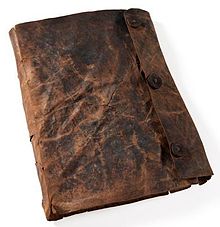
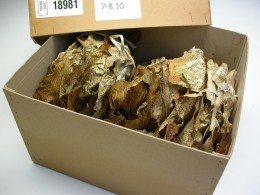
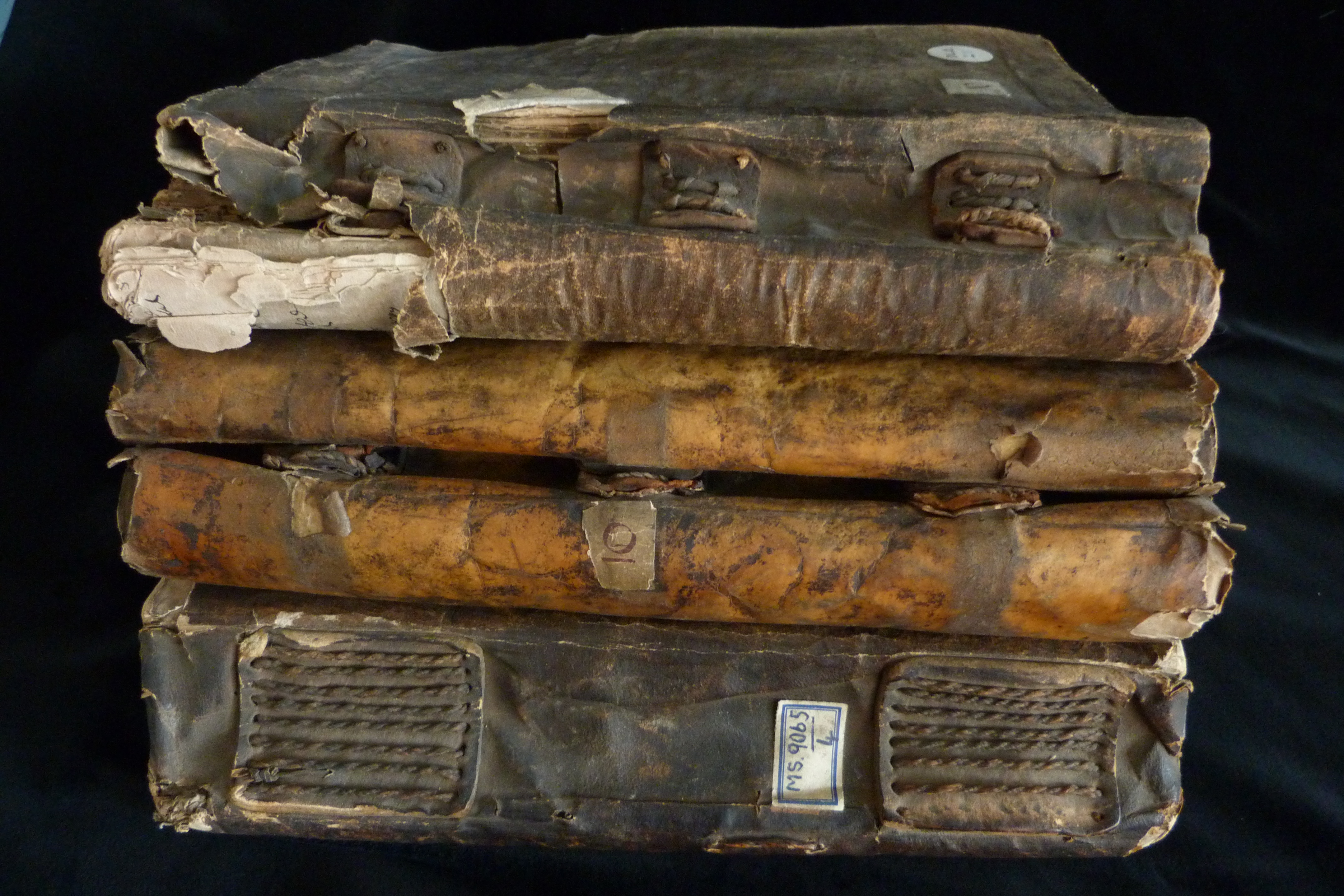
The book is made of 165 folios and is stored in 19 boxes.

There are also a lot of fragments which, at this stage, are impossible to place in any of the pages which survived the fire in 1786.

The light brown ink line which runs vertically along the left and right margin of the written area.

The light brown ink line which runs vertically along the left and right margin of the written area.

The pages are about A4 size (295×210 mm). On a closer look at the surface of the pages, calf skin may have been used to make the parchment. It was very difficult to find the traces of the hair follicles since most of the pages have a thick layer of gelatine on the surface.
There are no traces of either the binding format or of the sewing structure. Although the fire and the water have damaged most of the document’s surface, the worst damages are found on the spine fold of the pages.
Writing area: the page is ruled with a different ink than the one used for writing: a light brown line runs vertically on the sides of the written area.

Light lines are present horizontally as a ruling guide

Light lines are present horizontally as a ruling guide

Detail of the ink used for writing

Detail of the ink used for writing

A different ink, possibly a lead pen, was used for ruling the horizontal lines. It is really difficult to detect the latter and it even looks as though just some lines were ruled, not all of them.
The media used to write is a metallogallic ink.
The Great Parchment Book is written in Secretary Hand. This was a script which began to be used in England in the sixteenth century and continued until the late seventeenth century. Scripts evolve continuously and this is a fairly late example of Secretary Hand, when the script was already starting to incorporate more rounded, Roman, characters. This makes the script of the Great Parchment Book much more accessible and readable than pure, early Secretary Hand.
Looking through the pages it seems that different hands have written the text.

The next thing to do is to assess the condition of the parchment sheets. We will attempt to cover this in our next posts.

Approaches to Conservation

Posted on

We have now appointed the conservator who will treat the Great Parchment Book. Rachael Smither will work on the membranes for the next six months.

Her working approach will be of minimal intervention in order to facilitate the digitization of the pages.

The treatments will be localised to the areas where the writing is hidden by creases, folds and dirt.

The decision to work in this manner came from the realisation that the parchment is so damaged that a more invasive intervention could damage the material even further.
This modus operandi is also based on the Code of Ethics, promoted by the European Confederation of Conservator-Restorers’ Organisations and adopted by its General Assembly, Brussels 7 March 2003.

For the first weeks Rachael will assess the type of damages in the book and decide the best technique to use to relax the areas which present problems for the digitization process. Once the assessment is completed Rachael will then start to work on the membranes that need to be treated. We will record the stages of these treatments, show you pictures of the procedures, and the final results of the treatment.

I hope you will enjoy taking this challenging journey with us!

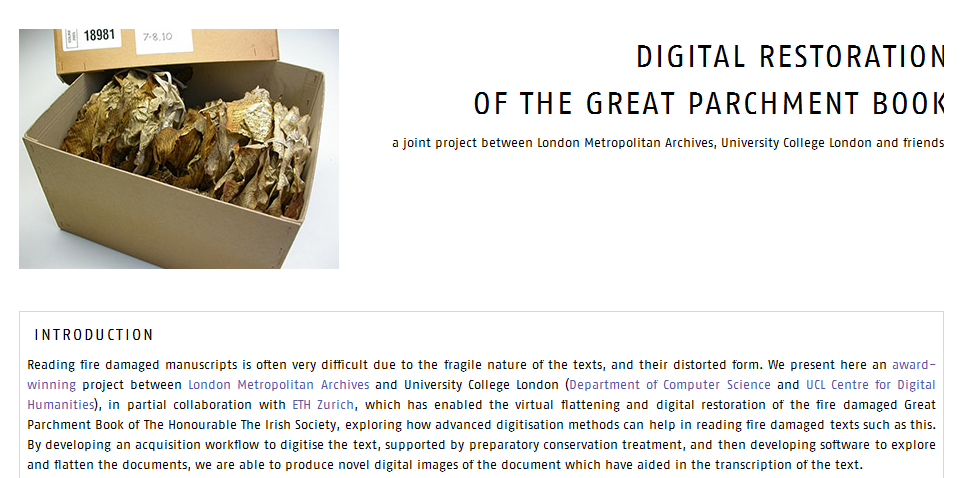
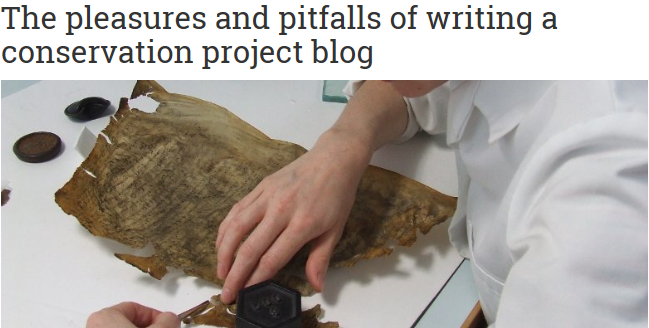
A membrane from the Great Parchment Book

A membrane from the Great Parchment Book

Welcome to the project blog!

Posted on

The Great Parchment Book is an early 17th century survey of the County of Londonderry. This manuscript has been described by the University of Ulster as forming almost a ‘Domesday Book of Derry’.

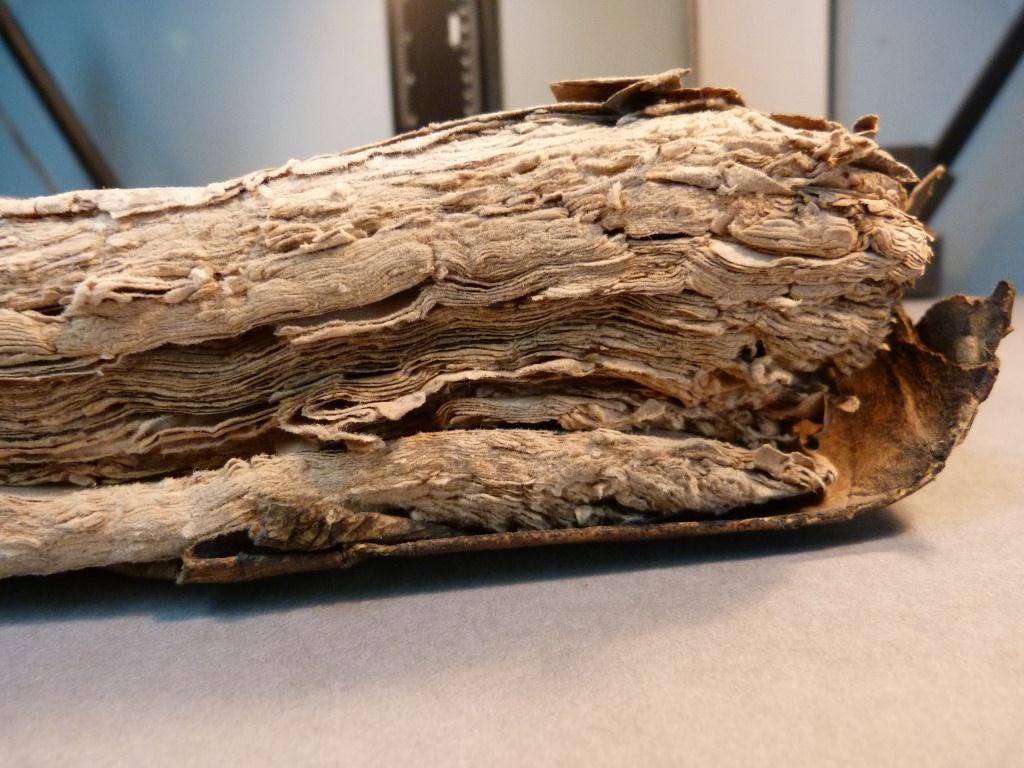
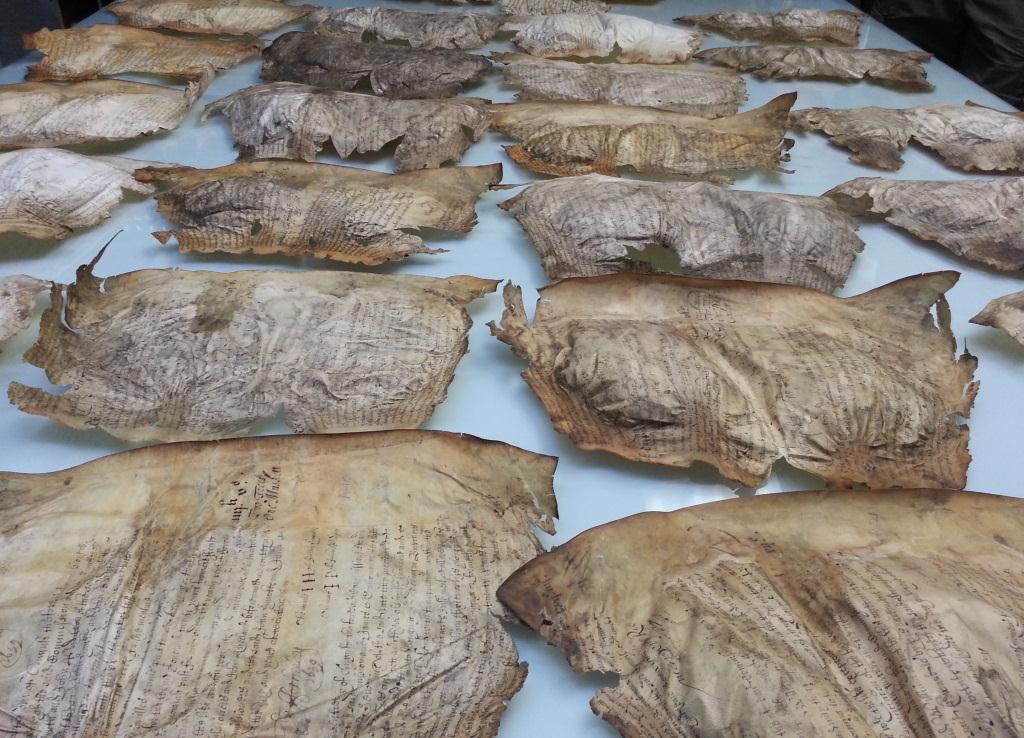
Moreover, it is a manuscript that has been completely inaccessible to scholars for over 200 years, since it was heavily damaged in a fire at Guildhall in 1786. The manuscript forms part of the collection of the Hon The Irish Society housed at London Metropolitan Archives. It is hoped that the development of new digital methodologies will allow the opening up of the obscured text and enable the production of usable 3-D digital images and a transcription of the complete manuscript.

These techniques have never been tried on manuscripts before, and so, if successful, would provide exciting possibilities for other damaged parchment manuscripts in the City of London’s collections and beyond.

This blog will record our journey.

The photographs on the ’Project’ page and those below should give you some idea of the challenges we face.

Page from the Great Parchment Book

Page from the Great Parchment Book

Page from the Great Parchment Book

Page from the Great Parchment Book

Page from the Great Parchment Book

Page from the Great Parchment Book